AI visibility for B2B SaaS
How B2B SaaS Can Improve Visibility in Search and AI Results
Short answer: make the right pages crawlable, state the product and category unambiguously, answer real buyer questions with original evidence, earn accurate third-party corroboration, and measure citations and conversions separately from rankings.
Why a SaaS brand can rank in Google and still be invisible in AI answers
The problem is increasingly familiar. A SaaS company ranks for its brand name, publishes useful blog posts, and may even win page-one positions for a few commercial keywords. Yet when a buyer asks ChatGPT, Claude, Perplexity, Copilot or Google’s AI features for the best tool for a specific job, the product is missing.
That gap is what people usually mean by AI visibility. The related labels—answer engine optimization (AEO) and generative engine optimization (GEO)—describe parts of the work, but they are not separate magic channels. Google’s own guidance is explicit: its generative search features are rooted in core search ranking and quality systems. A page still needs to be accessible, useful, indexable and eligible to appear in Search before it can be surfaced in generative results.
The practical difference is the shape of the discovery journey. A conventional search result gives the buyer a list of pages to inspect. An AI answer may synthesize several sources, resolve a comparison, summarize a workflow and recommend a shortlist before the buyer visits any site. This compresses the research stage. For SaaS teams, visibility now depends on more than owning a keyword: the product has to be understood as an entity, retrieved for the right question, supported by credible evidence and presented as a useful source.
The operating question is not “How do we manipulate an LLM?” It is “What would make our product easy to discover, accurately understand, safely recommend and confidently verify?”
Search discussions across SaaS communities repeatedly use phrases such as “how to get your SaaS recommended by ChatGPT,” “why is my SaaS invisible in AI search,” “B2B SaaS GEO,” and “how to measure AI citations.” Those discussions are useful evidence of the problem’s language, but not proof of a universal ranking formula. Treat community claims as hypotheses to test, not statistics to repeat.
How AI search finds, understands and cites SaaS sources
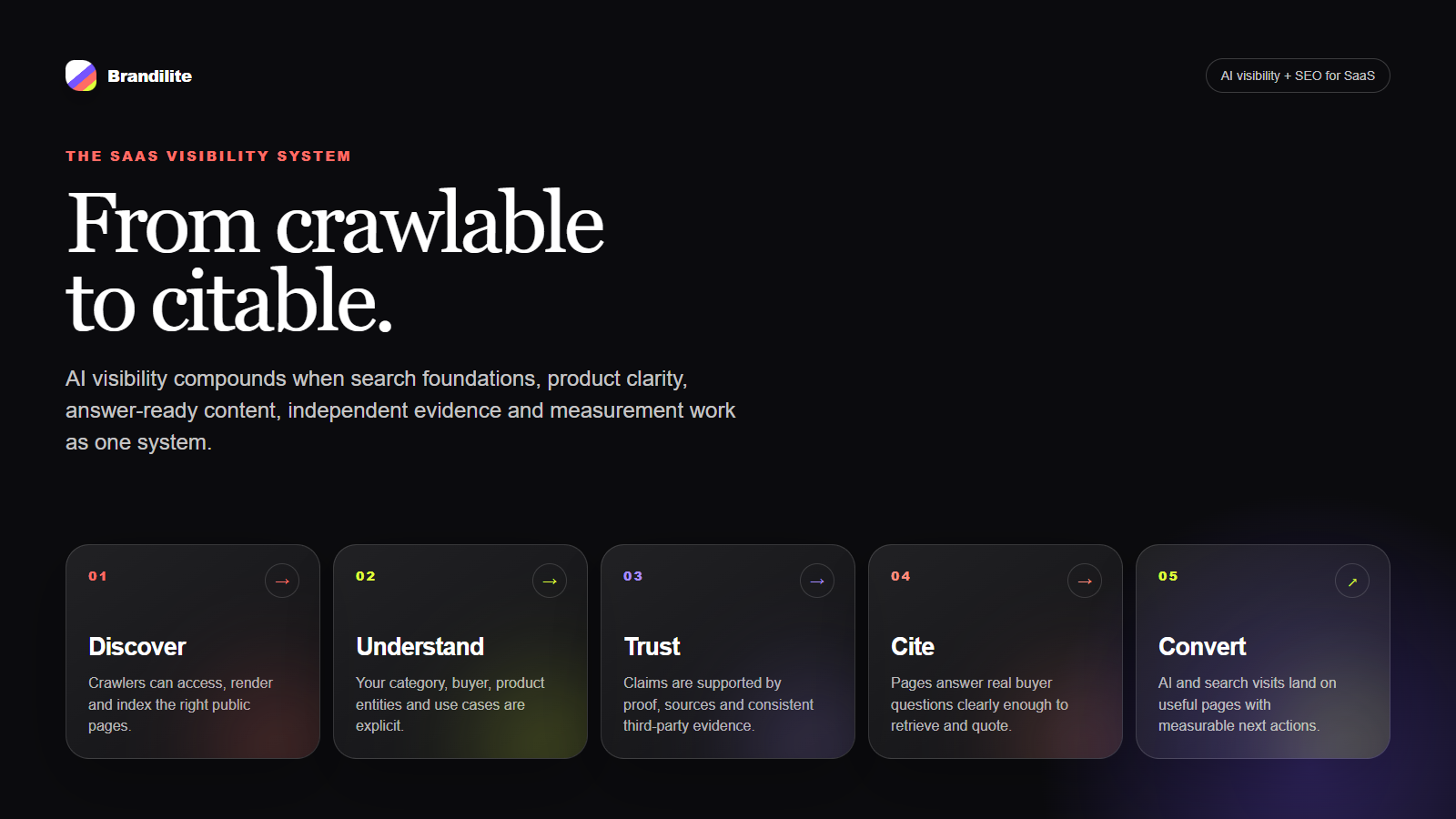
Every platform uses a different model, retrieval stack and interface, so there is no single cross-engine ranking factor list. A useful mental model is a five-stage pipeline.
1. Discovery: can the system access the page?
Important public pages need to be reachable through internal links, included in the correct sitemap, renderable without fragile client-side dependencies, and free from accidental noindex, canonical or robots conflicts. For ChatGPT search, OpenAI advises publishers not to block OAI-SearchBot if they want content to be discovered and cited. That is separate from GPTBot, which relates to potential model training. Do not combine the two controls into one policy decision.
For Google’s generative features, the foundation remains Google Search eligibility. For Microsoft surfaces, Bing Webmaster Tools provides crawl and indexing information alongside its AI Performance reporting. Perplexity also publishes crawler guidance. A crawler access check should therefore name the user agent, URL sample, response code and purpose rather than declaring vaguely that “AI bots are allowed.”
2. Retrieval: does the page match a real buyer problem?
AI systems often decompose a broad prompt into narrower retrieval questions. Google describes this as query fan-out. A prompt such as “What is the best customer-support platform for a 50-person B2B SaaS with Salesforce and EU data requirements?” can imply searches about category fit, team size, CRM integrations, security, residency, implementation effort, pricing and alternatives.
This does not justify creating hundreds of thin pages for prompt variations. It does justify building a coherent set of substantial pages around real jobs, constraints and decision criteria. One strong use-case page with verified examples, limits, integrations and implementation detail is more defensible than twenty near-duplicate pages with swapped industry names.
3. Extraction: is the answer easy to identify and quote accurately?
Answer-ready content helps a human and a retrieval system find the useful part quickly. Use a descriptive heading, give a direct answer near the start of the section, explain the reasoning, provide evidence, and state limitations. Tables can clarify comparisons. Visible FAQs can resolve objections. Definitions should be specific enough to distinguish your product from adjacent categories.
“Easy to extract” is not the same as writing robotic fragments. Google says there is no requirement to “chunk” every page into tiny sections or rewrite content exclusively for AI. Clarity, hierarchy and usefulness matter; artificial formatting rituals do not.
4. Corroboration: can the claim be checked beyond your website?
A SaaS website is naturally self-interested. Buyers—and answer systems assembling a response—may look for independent context: review profiles, reputable directories, customer documentation, integration marketplaces, expert articles, security attestations, community discussions and original research cited by others.
Corroboration is strongest when sources are accurate, relevant and earned. It is weakened by fake reviews, paid links that are not qualified, mass directory submissions, copied listicles and manufactured forum mentions. These tactics create brand risk and can conflict with search spam policies.
5. Selection and conversion: is this source useful for the final answer and the buyer’s next step?
A citation is only an intermediate outcome. The cited page must satisfy the question, represent the product accurately and make a sensible next action obvious. That could be starting a trial, viewing pricing, reading security documentation, testing an integration, comparing plans or requesting an audit. Measure the full path, not only the mention.
For the B2B SaaS fit criteria and commercial question map behind this approach, see AI visibility for B2B SaaS companies.
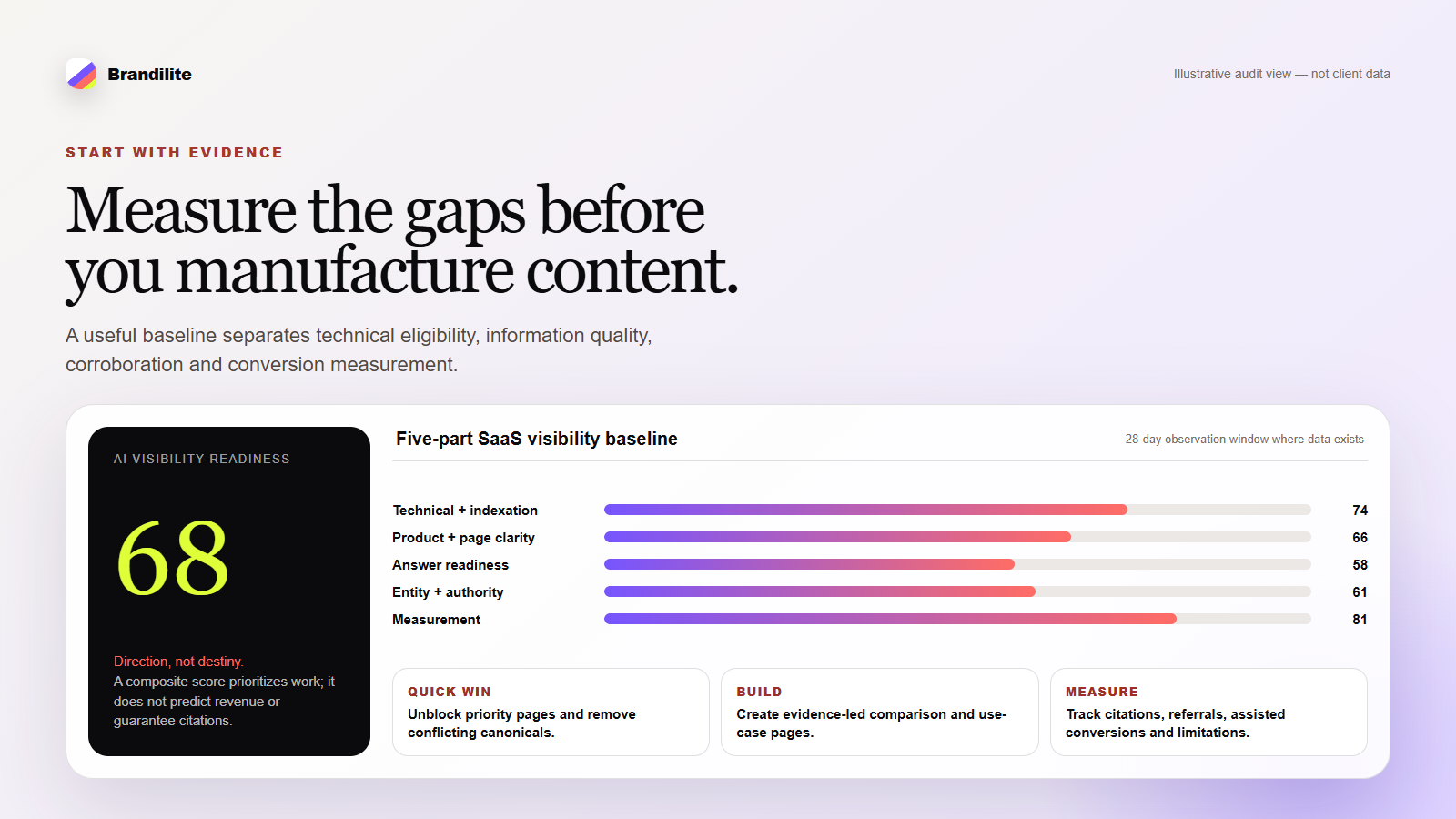
The five-part SaaS AI visibility audit
Start with a baseline before publishing more content. A credible audit should distinguish observations from assumptions and show the evidence behind each priority. The following five categories prevent a team from treating every visibility problem as a copywriting problem.
Category 1: technical eligibility and indexation
- Confirm the preferred protocol, hostname and canonical version of every priority URL.
- Inspect robots.txt, meta robots, X-Robots-Tag, redirects and canonical tags together.
- Verify Googlebot, Bingbot, OAI-SearchBot and other supported search crawlers receive a usable response.
- Check whether core product copy is present in rendered HTML and visible without an interaction.
- Review XML sitemaps, orphan pages, duplicate parameter URLs and stale documentation.
- Use Search Console and Bing Webmaster Tools to distinguish “discovered,” “crawled,” “indexed” and “performing.”
A common SaaS failure is a beautiful application-led marketing site whose key copy is delayed, hidden behind tabs, duplicated across canonical variants, or isolated from the rest of the site. Technical eligibility is not glamorous, but no answer format can cite a page that the relevant retrieval system cannot reliably access.
Category 2: product, category and page clarity
Write down the product’s category, primary buyer, job, differentiator, delivery model, pricing logic, supported integrations, deployment constraints and disqualifiers. Then compare that definition across the homepage, product pages, pricing, documentation, profiles and third-party listings.
Ambiguity compounds. If one page calls the product an “AI workspace,” another calls it an “automation agent,” and directory profiles list it as “project management,” a buyer has to reconstruct the category. State the broad category and the specific difference together. For example: “A customer-support QA platform for B2B SaaS teams that reviews conversations, detects coaching gaps and syncs findings to the help-desk workflow.”
Category 3: answer readiness and information design
Sample the commercial questions a qualified buyer asks before purchase. Does the site answer them directly, or force the buyer to infer the answer from feature slogans? For every priority question, record the best current URL, the answer’s completeness, the available evidence and the next action.
Strong answer sections usually contain:
- a precise heading that names the question or decision;
- a concise answer in the opening sentences;
- details, examples and limitations;
- visible proof such as screenshots, benchmarks, methodology or customer evidence;
- links to the deeper source of truth, such as docs, security or pricing;
- an update date and a responsible author or reviewer where freshness matters.
Category 4: entity evidence and earned authority
Inventory the places where the product is described outside its own domain. Check whether the name, category, URL, pricing status and positioning are consistent. Prioritize sources a real buyer uses, not directory volume for its own sake.
Then identify evidence the company can genuinely earn: original data, a reproducible benchmark, a technical teardown, a useful template, an expert contribution, an integration listing, a partner page, a conference resource or a customer-authored implementation story. The objective is to create useful reasons for relevant sources to mention the brand.
Category 5: measurement and conversion
Establish a 28-day baseline where data exists. Connect Google Search Console, GA4 and Bing Webmaster Tools. Confirm conversion events fire once, referral sources are preserved and assisted conversions can be reviewed. Record the current set of tracked prompts and the limitations of the collection method.
Do not collapse everything into one score. A composite can help prioritize work, but it should sit beside the underlying measures: indexed pages, non-brand impressions, AI citations, cited URLs, grounding queries, referral sessions, branded demand and qualified conversions.
Brandilite’s evidence methodology explains how observations, estimates and sampled signals are separated.
Build an answer-ready content architecture for SaaS
Most SaaS content plans overinvest in top-of-funnel blog posts and underinvest in pages that resolve purchase decisions. A more useful architecture connects category education, product evidence and conversion.
Homepage: define the product in one pass
The homepage should tell a new visitor what the product is, who it is for, what outcome it helps create, how it works and what the visitor should do next. Avoid a hero that can describe any software company. Pair the category with the distinctive mechanism or audience.
Category and “what is” pages: teach the market without inventing jargon
A category page should define the problem, explain the approaches, show who needs the solution, distinguish adjacent categories and connect the topic to the product honestly. If the market does not use your preferred category name, include the established vocabulary rather than expecting retrieval systems and buyers to infer it.
Use-case pages: organize around a job and constraint
A strong use-case page is not a duplicated landing page with a new noun. It should explain the starting condition, workflow, required inputs, product capabilities, implementation steps, expected evidence, limitations and relevant proof. Useful constraints include team size, industry regulation, data environment, integration stack and maturity.
Comparison and alternatives pages: help the buyer decide fairly
Comparison content is frequently retrieved because it matches high-intent questions. It is also easy to abuse. Build comparisons from explicit criteria, state who each option is best for, link to current sources, date the review and correct material changes. Include your own product’s limitations. A fair decision aid is more credible than a table where your brand wins every row.
Integration pages: explain the actual workflow
Do more than say “connect X with Y.” Document the trigger, data exchanged, permissions, setup steps, supported objects, common failure states and a concrete example. Link to both products’ documentation where possible. Accurate integration pages can answer technical evaluation prompts while reducing support friction.
Pricing and packaging: reduce ambiguity
If pricing is public, keep the page current and explain the unit, included usage, overages, contract terms, trial conditions and common fit. If pricing is not public, explain the buying process and what determines cost. An answer system cannot safely summarize information that the company withholds or contradicts across pages.
Security, privacy and trust: make high-stakes answers verifiable
Publish accurate information about data handling, subprocessors, retention, residency, access controls and attestations. Avoid implying a certification or legal conclusion that the company does not hold. For enterprise SaaS, security and compliance questions are part of discovery, not an afterthought.
Original research and operational resources: create non-commodity value
Google recommends valuable, non-commodity content with a real point of view. For SaaS, this can include anonymized product benchmarks, a transparent methodology, a teardown based on first-party experience, a calculator with stated assumptions, a template used internally, or a dataset others can inspect. These assets are useful to buyers and give publishers a legitimate reason to cite the brand.
A useful page pattern
Answer → evidence → method → limitation → next step. This structure serves the impatient buyer without sacrificing technical depth.
For implementation across technical SEO, commercial content, product evidence, authority and measurement, see the B2B SaaS AI visibility service.
Build authority without manufacturing mentions or buying ranking links
Off-page work is often described as “getting backlinks,” but the more useful objective is earned corroboration. The brand should appear in contexts that help buyers verify what it is and whether it fits.
Start with source accuracy and reclamation
- Claim high-value profiles and remove conflicting product descriptions.
- Correct outdated URLs, pricing labels, categories and screenshots.
- Recover legitimate unlinked brand mentions where a link helps the reader.
- Ask partners to list real integrations and customer relationships accurately.
- Keep founder, author and reviewer profiles consistent with visible site content.
Create evidence worth pitching
Before sending outreach, ask: “What will the recipient’s audience gain?” A benchmark, expert dataset, calculator, original diagram, practical checklist or documented experiment is a stronger pitch than “we published another ultimate guide.” Segment outreach by relevance, reference the recipient’s work, and make the requested action small.
Use reviews and directories selectively
Prioritize platforms your buyers actually consult. Complete the product information, use current screenshots and invite authentic customers to leave honest feedback without scripting the sentiment. A smaller set of accurate, active profiles is usually more valuable than hundreds of thin submissions.
Avoid the shortcuts
Do not buy followed links as ranking inventory, generate fake reviews, automate forum praise, or syndicate near-identical “best tools” posts. Google specifically warns against inauthentic mentions and link spam. If a placement is paid or sponsored, qualify the link appropriately. Authority work should survive the question: “Would this source and mention still be useful if rankings did not exist?”
Technical AEO and GEO: what actually deserves engineering time
Technical AEO/GEO should improve accessibility and information quality, not bolt on unsupported “AI schema.”
Use semantic structure that matches the page
Use one visible H1, a logical heading hierarchy, descriptive link text, lists for real lists, tables for comparable facts, and labels for controls. Keep critical text server-rendered and visible. Accessible structure also helps browser agents interpret interactive pages; OpenAI’s publisher guidance specifically points to descriptive roles, labels and states for interactive elements.
Add structured data only when it matches visible content
Use appropriate types such as Organization, SoftwareApplication, Product, Article, BreadcrumbList and visible author information when the page qualifies. Validate the markup and keep it synchronized with the page. Structured data can support conventional search features, but Google says no special schema is required for generative AI results.
Make images informative and discoverable
Give diagrams a descriptive filename and alt text, place them near the relevant explanation, provide a caption when context matters, and compress them responsibly. Avoid putting the only version of an important claim inside an image. Google’s generative search guidance explicitly recommends relevant, high-quality images and video because they create additional discovery opportunities.
Treat llms.txt as optional, not a ranking requirement
Some services may use emerging machine-readable conventions, but Google says it does not use llms.txt for Search. Implement it only for a defined consumer and maintenance reason. It cannot replace crawlability, useful pages or evidence.
Control search crawling and training separately
A policy for search discovery is not automatically a policy for model training. Document the purpose of each user agent, test the effective robots response, and involve legal or security owners when the decision changes data-use permissions. Avoid copying a generic robots file without understanding the operational consequence.
How to measure SaaS AI visibility without fake precision
AI answers vary by platform, model, location, account state, phrasing and time. A prompt tracker is a sample—not a census. It is still useful if the prompt panel is commercially meaningful, the method is stable and the report states its limits.
Build a balanced prompt panel
Start with 25–50 prompts grouped by buyer intent:
- Category: “What tools help B2B SaaS teams review support quality?”
- Use case: “How can a SaaS company reduce onboarding drop-off?”
- Comparison: “Compare [category A] and [category B] for a 50-person team.”
- Alternatives: “What are alternatives to [known product] for EU-hosted data?”
- Risk and trust: “Which tools support SSO, audit logs and EU residency?”
- Implementation: “How long does it take to integrate [category] with Salesforce?”
Store the exact prompt, engine, model or surface, date, market, observed brands, citation URLs, sentiment and result notes. Test on a fixed cadence. Do not turn a weekly mention count into a guaranteed “rank.”
Use first-party platform data where available
Google’s Generative AI performance report in Search Console can show how content is discovered through Google’s generative features where the report is available. Bing’s AI Performance dashboard reports total citations, cited pages, sampled grounding queries and trends across supported Microsoft experiences. OpenAI adds utm_source=chatgpt.com to referral URLs, which supports referral analysis in GA4.
Report business outcomes separately
A useful monthly scorecard separates:
- technical eligibility and index coverage;
- non-brand search impressions and clicks;
- AI mentions and citations by sampled prompt cohort;
- cited pages and cited-source types;
- AI referral sessions and landing pages;
- assisted and last-touch conversions;
- qualified lead quality and revenue where attribution is reliable;
- work shipped, observed limitations and next priorities.
A citation can be valuable without producing a click, and a referral can influence a deal without receiving last-touch credit. Keep these measures related but distinct.
A practical 30 / 60 / 90-day SaaS AI visibility roadmap
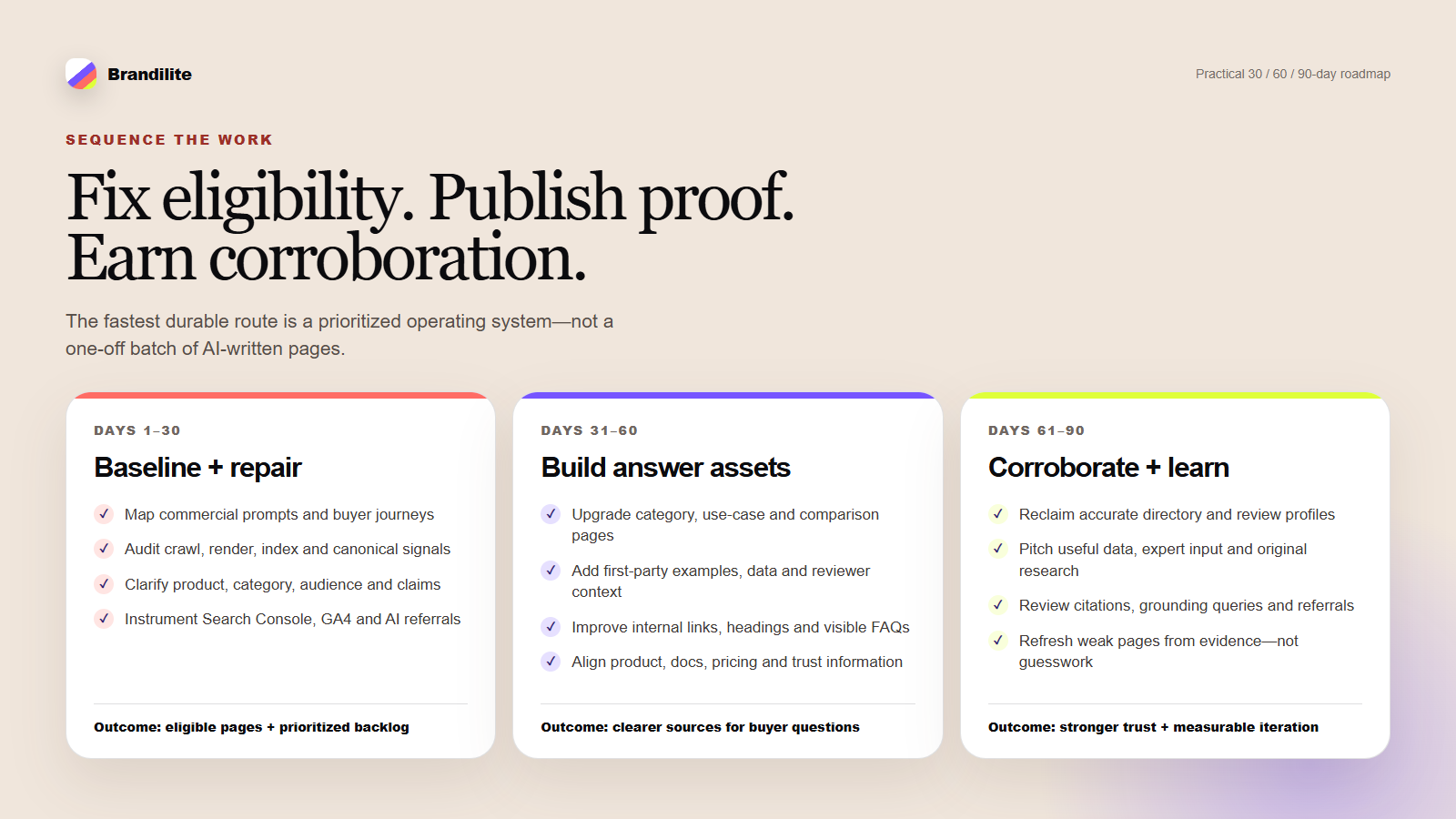
Days 1–30: establish the baseline and repair eligibility
- Define priority audiences, commercial jobs, products and markets.
- Build the initial prompt and query panel from Search Console, sales questions, support tickets, community language and competitor research.
- Crawl the public site and audit robots, canonicals, sitemaps, rendering, internal links and indexation.
- Check OAI-SearchBot and other relevant crawler policies separately from training controls.
- Normalize product/category language across the homepage, product, pricing, docs and high-value profiles.
- Instrument GA4 referrals, conversions and Search Console/Bing access.
- Prioritize fixes by expected buyer impact, evidence, effort and dependency.
Days 31–60: build answer assets and product evidence
- Upgrade the highest-value category, use-case, integration, comparison and trust pages.
- Add direct answers, proof, examples, limitations, reviewer context and update dates.
- Strengthen internal links from educational content to commercial decision pages.
- Create one non-commodity asset: original data, a benchmark, a transparent teardown or a practical tool.
- Align structured data with visible product and article content.
- Request recrawling or use supported update protocols after material changes.
Days 61–90: earn corroboration and iterate from evidence
- Correct high-value directory, review, integration and partner profiles.
- Run targeted outreach for the original asset, expert contribution or useful data.
- Review cited pages, sampled grounding queries, prompt observations and referral conversions.
- Compare what gets cited with what drives qualified actions; they may be different pages.
- Refresh weak or inaccurate sections and document what changed.
- Set the next quarterly backlog from observed evidence—not a content-volume target.
SaaS AI visibility implementation checklist
Technical
- Priority pages return 200, render useful content and use intentional canonicals.
- Robots and meta directives match the company’s search and training decisions.
- XML sitemaps contain indexable, preferred URLs only.
- Core pages are internally linked and not dependent on an interaction to reveal essential copy.
Content and AEO
- The product, audience, category, jobs and limitations are explicit.
- Commercial questions have substantial, maintained destination pages.
- Answer sections lead with clarity and continue with evidence and method.
- Comparisons are sourced, dated, fair and useful even when the brand is not the best fit.
GEO and authority
- Important external profiles describe the product consistently.
- Claims can be corroborated through real reviews, partners, integrations or independent coverage.
- Outreach offers original value rather than requesting arbitrary backlinks.
- Paid or sponsored links are qualified appropriately; fake mentions are prohibited.
Measurement
- The prompt panel records engine, date, market, citations and limitations.
- Search Console, Bing Webmaster Tools and GA4 baselines are stored.
- AI referral sessions are separated from confirmed conversions.
- Monthly reporting shows outcomes, shipped work, limits and next actions.
Frequently asked questions about AI visibility for SaaS
What is AI visibility for SaaS?
AI visibility is how often and how accurately a SaaS brand, product or page appears in AI-assisted discovery experiences. It can include mentions, recommendations, citations, impressions, referral visits, sentiment and resulting conversions. It is broader than any single prompt rank.
What is the difference between SEO, AEO and GEO?
SEO covers technical eligibility, relevance, content quality, internal linking and authority across search. AEO emphasizes clear answers and information design for question-led discovery. GEO focuses on how generative systems understand, retrieve, mention and cite sources. In practice, durable AEO and GEO depend on strong SEO foundations.
How do I get my SaaS recommended by ChatGPT?
There is no guaranteed submission or ranking shortcut. Allow OAI-SearchBot if inclusion in ChatGPT search matches your policy, publish accessible and genuinely useful pages, make product facts clear, support claims with evidence, maintain accurate third-party profiles and track ChatGPT referrals. Recommendations remain query- and model-dependent.
Does schema markup make a SaaS brand rank in AI answers?
No. Use structured data when it accurately represents visible content and supports conventional search features. Google states that no special schema is required for generative AI search. Schema cannot compensate for inaccessible pages, vague claims or weak evidence.
Do SaaS companies need an llms.txt file?
Not for Google Search. Google says it does not use llms.txt for Search or its generative features. Another service may choose to consume the format, so implement it only when you have a defined use case and owner. It is not a substitute for SEO.
How long does SaaS GEO take?
Technical fixes can improve eligibility quickly after recrawling, but reliable visibility and authority usually compound over months. Timing depends on site history, demand, competition, content quality, external evidence and how often relevant systems refresh their sources. Avoid any provider that guarantees a fixed citation date.
How should a small SaaS team start?
Choose one commercial product or use case. Audit its crawl/index status, clarify the category and buyer, upgrade the core decision pages, correct the most important third-party profiles, and track a small prompt cohort plus conversions. Expand only after the first workstream is measurable.
Can AI-generated content improve AI visibility?
AI can assist research, outlining and editing, but publishing commodity summaries at scale adds little durable value and can create factual risk. Use subject-matter review, first-party evidence, original examples, source verification and a clear editorial standard. The final page should offer something a generic model could not produce from existing summaries alone.
Practical next steps
Use our AI citation measurement guide and blank observation template to record a consistent baseline. If you are choosing outside support, read how to evaluate an AEO agency.
Sources and further reading
- Google Search Central: Optimizing your website for generative AI features
- OpenAI: Publishers and Developers FAQ
- Bing Webmaster Blog: AI Performance in Bing Webmaster Tools
- Perplexity: crawler guidance
- Google Search spam policies
A useful next step
Want to know where your SaaS is missing from the buyer’s answer set?
Get three evidence-linked SEO, AEO or GEO findings from your B2B SaaS site, plus one priority next step. No sales call required.
Need a fuller diagnostic? Choose the $299 paid diagnostic. Any credit toward an eligible subscription must be confirmed in your written checkout offer and is subject to the credit terms.