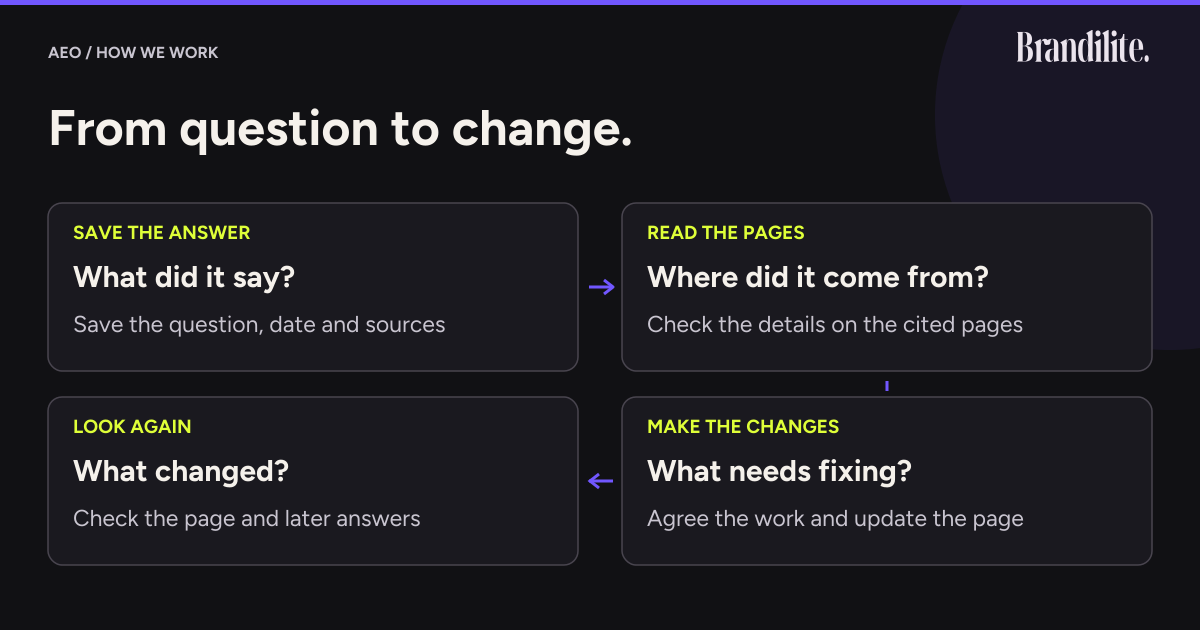
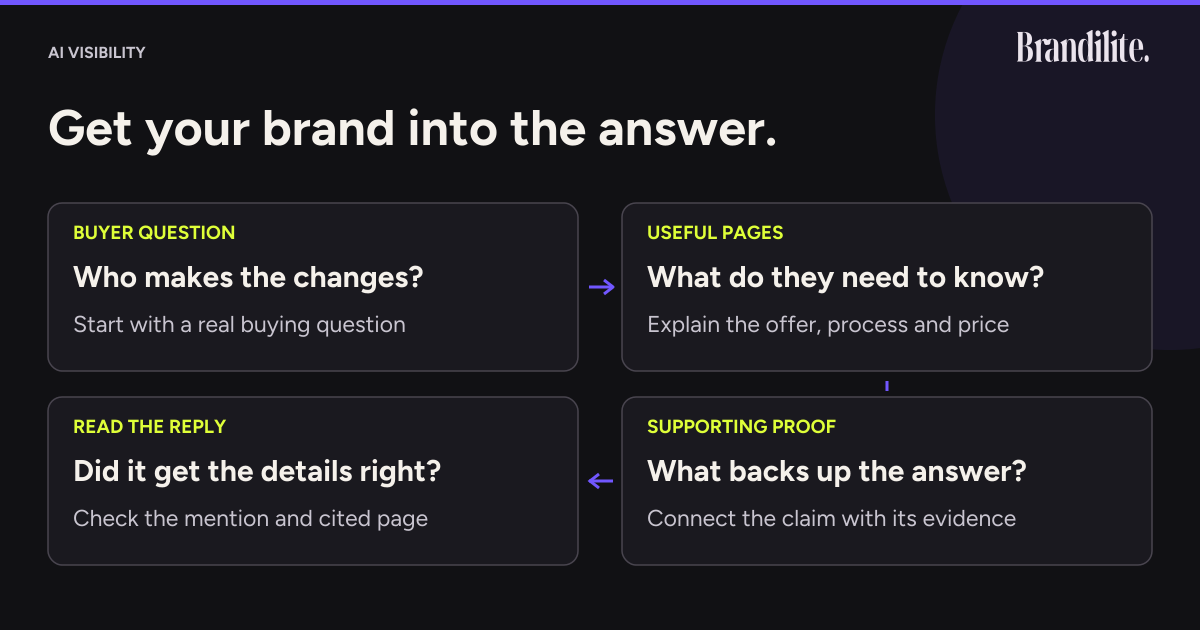
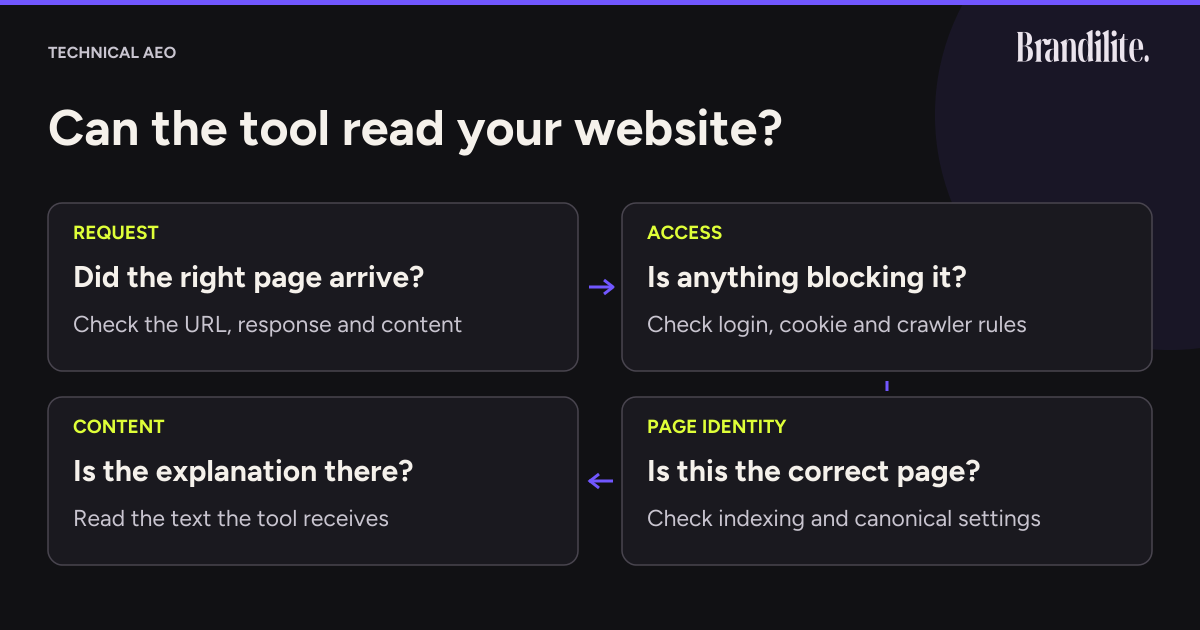
Let’s walk through those questions using a real restaurant page, the information it gives a potential customer, and the results you could reasonably measure. You can use the same approach for a product, a service or your own company website.
SEO, AEO and GEO: what do you actually do differently?
SEO means search engine optimisation. It includes helping search engines find your pages and helping the right people discover them. AEO means answer engine optimisation. The focus is on whether your content can help answer a question. GEO means generative engine optimisation, usually referring to visibility in answers created by AI systems.
People use the last two terms in different ways. Treat the definitions as a starting point for a conversation, then ask what someone proposes to change.
| If you’re discussing… | Bring it back to this question | A useful job might be… |
|---|---|---|
| SEO | Can a person searching for this find and use the page? | Fix an indexing problem, improve the page title or add a relevant internal link. |
| AEO | Does the page answer what the person needs to know? | Explain the price, process, suitability or limitation that currently takes an email to find out. |
| GEO | What might support an AI answer about this business? | Improve the source information and correct outdated facts on relevant public pages. |
There’s plenty of overlap. A useful pricing page can help a Google visitor, answer a question in ChatGPT search and save your sales team from explaining the same thing again.
Google’s current guidance says its generative search features rely on Search’s ranking and quality systems. Google still considers the work SEO. That’s a good reason to keep asking about the actual task instead of getting stuck on the label.
The research paper that introduced GEO studied ways to change how source material appears in generated answers. It used a benchmark and experiments. It’s worth reading if you’re interested in the research, but it isn’t a promise that adding a statistic to your page will bring you more customers.
The confusion comes up in practice too. In this r/SEO discussion, a poster who says they have ten years in SEO asks what changes and which platforms provide useful analytics. Those are sensible questions to take into any agency conversation.
First, check whether your page can appear
Before rewriting your copy, check that the page you care about is available to the system you want to reach. It’s a boring place to start. It can also stop you spending a month improving something that cannot currently appear.
Open the URL you actually promote. Check its indexing status, the version identified as canonical and any instructions limiting what search engines can show. Then check whether a person can reach it from a relevant page on your website. A useful service page tucked away with no internal links deserves attention.
Google now has a Search generative AI control in Search Console. It manages inclusion in the applicable AI features separately from ordinary Search. The default for a top level property is to include the site; a child property may inherit its parent’s setting. Check what applies to your site instead of assuming that indexing answers the whole question.
OpenAI also gives publishers separate choices for its search crawler and its training crawler. Its crawler documentation explains that distinction. If your company has chosen to limit training, check the search settings separately. You don’t have to abandon that training decision just to investigate ChatGPT search visibility.
Keep structured data accurate when you use it. Google’s documentation explains how markup can describe page content and support eligible search features. The price, company details or product information still need to be correct on the page itself.
Google says special AI text files and special schema aren’t required for its generative search features. So if someone recommends “AI markup”, ask them to show you what it describes and the documented reason for adding it. You should be able to understand the answer without buying another tool.
A real example: booking private dining in Miami
Someone organising dinner for 30 colleagues has practical questions. Will everyone fit? Is the space private? Can they see the layout? How do they ask about a date?
Look at Zuma Miami’s private dining page. It gives the organiser more to work with than a broad promise of an unforgettable evening. At the time of this review, the private room lists capacity for 36 seated guests and 20 in a boardroom setup. There are room photographs, a floorplan link, a way to explore the space and an enquiry form.
Those details change the decision. A seated dinner for 30 people and a boardroom meeting for 30 people aren’t the same request. A single headline saying “capacity 36” would leave an awkward gap. The separate figures give the organiser a reason to ask the right follow up question.
Now apply the SEO, AEO and GEO questions to that page:
- Can someone searching for private dining in Miami reach the right location page?
- Does the page answer the capacity and room questions that matter to their event?
- Are the details current and consistent with what the venue team will confirm?
- Can the person send an enquiry with the date, group size and event type?
Our published Zuma case study includes a captured ChatGPT answer about dining options for meetings in Miami that cited the venue’s private dining page. That observation is dated 29 July 2026 in the report. It’s a real example of a specific page supporting an answer, rather than a claim that every event question now produces the same result.
You can do this review for your own business. For software, the equivalent details might be supported integrations, access permissions and setup steps. For a professional service, they might be who carries out the work, what the fee includes and what the client needs to supply.
Write down the question your customer asks just before they’re ready to enquire. Open the page you expect them to use. If the answer is missing, buried in a brochure or only available after a call, you have a clear place to start.
Google’s people first content guidance asks whether the intended reader can learn enough to achieve their goal. That’s a better review question than whether every paragraph is the length an AI optimisation checklist told you to use.
Make it easy to check what you’re claiming
Good details lose their value when they contradict each other. If your product page says an integration is available, the help page says it’s coming soon and a public listing calls it discontinued, a buyer has to work out which version to believe.
Start with the facts people use to choose you. Pick five claims from your main sales page and put a supporting link next to each one. A feature should connect to current documentation. A result should connect to an approved case study with dates and a clear metric. A service promise should agree with the scope a client will actually receive.
This exercise tends to expose a different problem from “we need more content”. You may already have the right information. It might be out of date, scattered across pages or described differently by each team.
For the venue example, the practical job is to keep capacities, room options, enquiry routes and current availability information in order. Availability itself still needs confirmation from the venue. A static page cannot promise that a room is free on the date someone wants.
Then look at the outside pages that matter to the decision. A relevant profile might list an old address. An integration directory might describe an earlier product version. A review might be accurate for the year it was written but need context today. Use the available correction process where there is a genuine factual problem.
You don’t need to manufacture praise across the internet. You need a useful page that says what the business actually does, with enough support for a reader to judge it. Our methodology explains how we connect the starting observations with changes that a client can review.
Read the results without fooling yourself
A mention tells you that the brand appeared. A citation gives a link to a source. A visit means someone arrived on the site. An enquiry means they took a further step. Keep those apart when you review the work.
The Zuma case study gives a useful example. Its US Semrush AI visibility score moved from 31 out of 100 in October 2025 to 56 on 8 September 2026. That is a gain of 25 points in that benchmark. It doesn’t tell you that restaurant bookings grew by the same amount, and it doesn’t identify one change as the cause.
For your own checks, keep a manageable set of customer questions. Record what you asked, where you asked it, the date, the relevant market and the sources shown. Repeat the questions and keep the earlier answers. You’ll learn more from that record than from saving the one screenshot where your brand looked good.
Google’s Generative AI performance report now provides impressions for supported Search AI features, including AI Overviews and AI Mode. You can look at pages and the available dimensions. The report may not appear when a site has too few impressions. It doesn’t give you a separate count of qualified enquiries.
Bing’s AI Performance shows citation activity across supported experiences, including cited pages and sampled grounding queries. Its Topics Portfolio beta can help with topics and opportunities when enough data is available. Keep the limits of each report beside the figures you share.
Then follow what people do on your own website, using the analytics and consent arrangements you have in place. Are suitable visitors reading the page? Does the enquiry form work? Are the enquiries relevant? A person may return later through another route, so the referral report won’t explain every sale that an AI answer may have influenced.
You’re looking for information that helps you make a decision. If answers keep using an old price, fix the source carrying that price. If the right people arrive but keep asking what the service includes, improve the scope explanation. A higher score alone doesn’t tell you which of those jobs to do.
Choose one useful job for this month
Bring one page and one customer question to your next marketing discussion. Ask the person proposing the work to show you the problem, explain the change and say how you’ll check that it’s done.
| What you find | A sensible next job | What you should receive |
|---|---|---|
| The intended page cannot appear in the relevant experience. | Check access, indexing and the applicable inclusion settings. | The actual issue, the change made and a fresh check. |
| The page is available but basic buying questions are unanswered. | Add the missing fit, price, process or limitation details. | A page a potential customer can use to make a decision. |
| Public details disagree. | Verify the current fact and correct the relevant sources. | The corrected pages and a note of anything still waiting on another publisher. |
| An AI answer gives an outdated description. | Inspect its cited source before commissioning more articles. | The source checked, the correction where possible and later answer observations. |
| Suitable visitors arrive but enquiries are poor. | Review the offer and the next step. | A clearer explanation, a working enquiry route and a way to track suitable responses. |
If the budget is small, choose the problem closest to a real customer decision. A restaurant page missing its room capacities needs those details before it needs another article about dining trends. A software page with an unclear integration needs an honest explanation before another page calling the product innovative.
That gives you something useful to approve. You can see what will change and why you’re paying for it. The programme may be called SEO, AEO or GEO. Your customer should get a better answer when they reach the page.