We’re Brandilite. We help businesses fix the pages, product information and public sources that shape how AI tools describe them. Here’s what that looks like in practice.
We start with the questions your customers ask
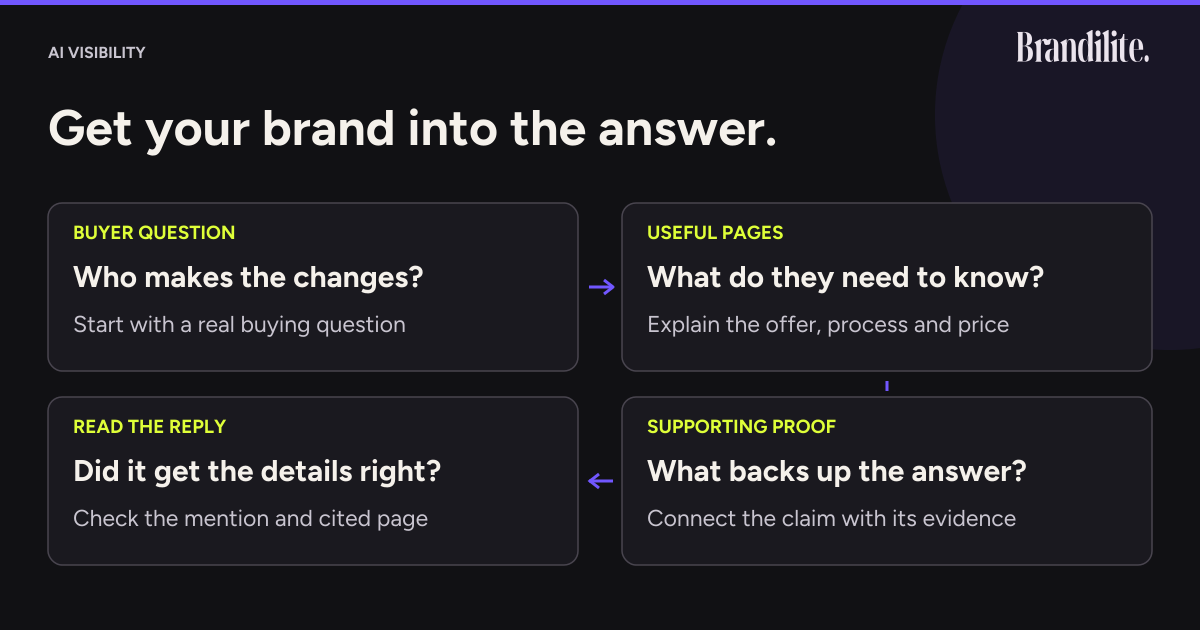
Say you sell booking software to small hotels. Your website talks about “better guest experiences.” Your customers have more immediate concerns. Can they take a deposit? Can guests change a booking? Will the software work with the payment provider they already use?
Those details help someone decide whether to put you on their shortlist. They also give us something useful to investigate when an AI answer leaves your brand out or gets a feature wrong.
We begin by agreeing which questions matter to your business. Sales emails and support conversations are good places to look. So are the objections that come up just before someone buys. We want the questions your team recognises, including the awkward ones about price, setup and limitations.
Then we look at selected answers and read the pages they cite. We save the question, date, platform and sources so you can see what we found. If the answer mentions another product, we look at what information supports it. If it describes yours incorrectly, we try to find where that description came from.
The hotel software example is fictional. It shows the difference between a vague request to “do AEO” and a question someone can work on: does the product page clearly explain deposits, and do the linked instructions show how they work?
You know your product. We need that knowledge to check the answer properly. If a feature is still being built, tell us. If a service only covers certain locations, say which ones. Good research starts with getting the business facts right.
Then we fix the information people need to choose you
Sometimes the right answer is already on your site, buried in a help page that nobody links to. Sometimes the page describes a feature your team stopped offering a year ago. Sometimes the information only exists in the founder’s head.
The work depends on what we find. We might rewrite a service page so it explains who it suits, add a useful comparison, correct an old company profile or help your developer fix an indexing problem. You can see the kinds of work covered by our AEO service.
For the fictional hotel product, a useful page could show what happens from the first deposit to the final payment. It could explain cancellations, refunds and which parts the hotel controls. Screenshots would show the actual settings. Links would take the reader to the current instructions.
That gives a hotel owner something to assess. “A seamless booking solution” leaves them with more questions.
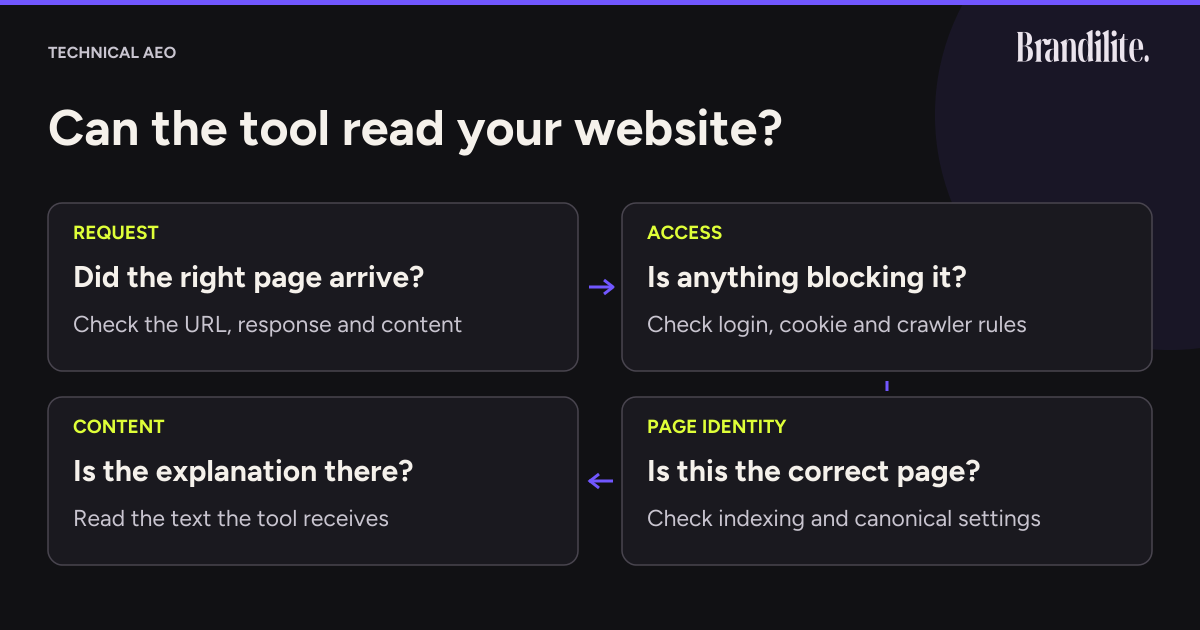
We also check whether search systems can reach the important information. Your page might load for you while a crawler gets a security challenge or an old address. That is a job for the developer or hosting team before anyone spends another week polishing the copy.
Google’s guidance for AI search still points website owners towards useful text, sensible internal links and accurate information. The same page needs to work for the person deciding whether to buy.
Access settings need a little care. OpenAI’s documentation has separate rules for content used in search and content that may be used for training. We check the setting that affects the problem. We don’t change a company’s training policy just to tick a box on a report.
You get help making the changes
You should know what happens after the audit. Who writes the page? Who makes the website change? What do you need to approve? What is waiting on your team?
We do the research and help make the changes we agree with you. We work remotely, with requests, approvals and updates in writing. Our About page explains that setup. You can get started without booking a call, though we still need your answers when a business fact is unclear.
Before starting a change, we explain the problem, the page involved and what we plan to do. You can ask questions and review the work. If we need a developer, product owner or account login, we say so rather than leaving the task quietly stuck.
Here is another fictional situation. A business sells an annual software plan, but an old partner profile still says the product is free. An AI answer picks up that description. The immediate job is to confirm the current offer, correct the profile through its editing process and check the relevant pricing page. That is a specific fix you can see.
After a change goes live, we check the page again and record what changed. Later answer checks show whether the description has moved too. The corrected source and the AI answer are separate things to review. A saved website edit tells us the page changed; it doesn’t tell us what every buyer will now see.
You also need room to get on with your own job. Written updates let you review a draft, answer a question or approve a change when you have the time. Keep the person who knows the product involved, and name someone who can make decisions. Long approval gaps slow down useful work just as much as technical problems do.
Here is the result we can show you
Zuma’s published case study covers a full SEO and AEO engagement. The US Semrush AI visibility score was 31 out of 100 in October 2025 and 56 out of 100 on 8 September 2026. That is an increase of 25 points.
The case study includes the original reports and a breakdown by platform:
| Platform | October 2025 | 8 September 2026 | Change |
|---|---|---|---|
| ChatGPT | 38 | 57 | 19 points |
| Google AI Overview | 18 | 47 | 29 points |
| Google AI Mode | 36 | 60 | 24 points |
Source: Semrush AI Visibility, United States. Scores are out of 100 and describe those historical reporting dates.
There is a useful distinction behind the numbers. Semrush describes the score as a benchmark of a brand’s presence in AI answers. It is not a measure of bookings or revenue. This case also covers SEO alongside AEO, so the comparison does not isolate one tactic as the cause of the improvement.
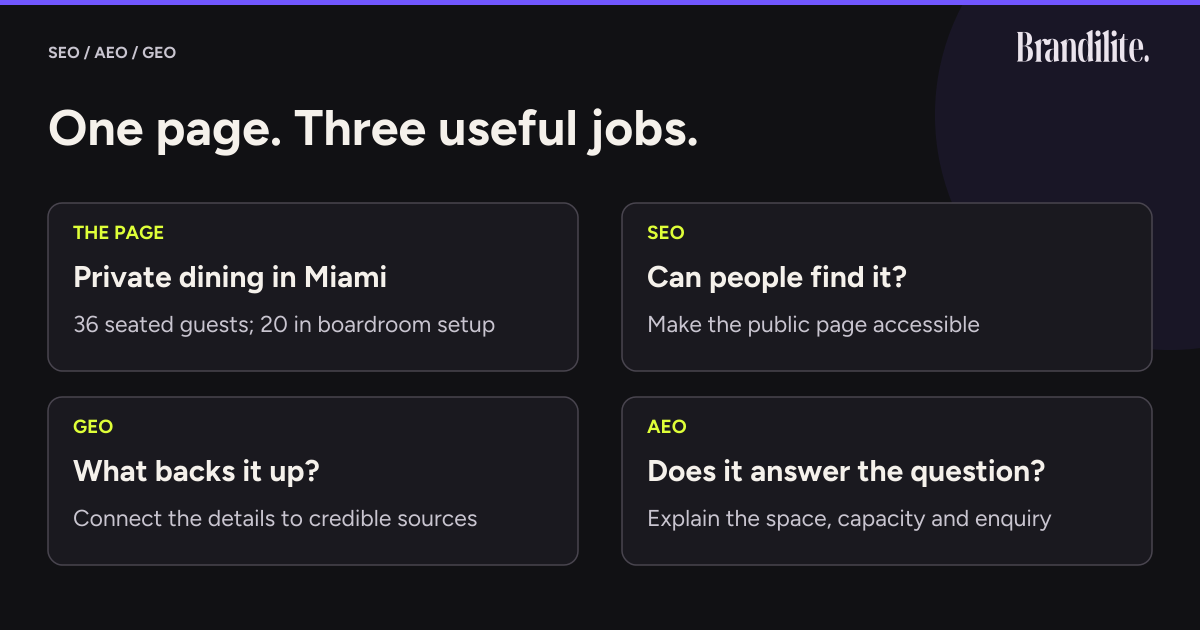
The page includes examples of the questions where Zuma appeared. One concerns dining options for an offsite meeting in Miami, with a citation to its private dining page. That is the sort of detail worth opening. It connects the number to something a potential customer might actually need.
When you look at a result, check the dates, country and source before judging it. Ask what the number means. Then open a few of the answers behind it. You’ll have a much better conversation about the work when you can see the underlying example.
Pick a plan that fits the problem
You can begin with a free public website review. If you need a fuller diagnosis and plan, Brandilite’s published pricing lists an optional $299 diagnostic. Monthly implementation plans are $999, $1,999 and $3,999, in USD. Check the current page for the full inclusions before choosing one.
The difference is the amount of work we can take on at once. Larger plans allow more pages, content, research and outreach activity. Buying the largest one only makes sense if there is enough useful work and enough support from your side to get it done.
Suppose your website has five main service pages. Two are vague, one has an indexing issue, and nobody has set up enquiry tracking properly. That is a fairly clear starting list. Fixing it could be a better first use of the budget than commissioning a large run of articles.
A bigger product site may need help across several parts of the business. The documentation team could be correcting old information while a developer works on templates and a writer builds a comparison page. That takes more coordination and capacity. We should explain those needs before recommending the plan.
Some businesses already have a writer and developer who can make the changes. Tell us what they can handle. You should understand what Brandilite will do and what remains with your team, including anything that needs a separate development quote.
For outreach, ask what the fee covers. Researching a relevant publication, preparing a useful contribution and sending a pitch are work someone can agree to deliver. An independent publisher still decides whether to accept it. A placement should never quietly appear in the proposal as though it were inventory sitting on a shelf.
A few things to ask us before you decide
Bring one real question from a customer and one page from your website. Ask us how we would investigate it. You’ll learn plenty from that example.
Ask who will write or edit the page, how you will review it and what happens if the first recommendation turns out to be wrong. You should feel comfortable challenging a finding. Your team may know a reason for a setup that an outside reviewer has missed.
Ask what will appear in the report. A brand mention means the name appeared in a saved answer. A citation means a page was linked as a source. A visit means someone reached the website through a measurable route. An enquiry means they took another step. Those are different events, and a report should let you follow them without mixing them together.
We also want to know what you count as a suitable enquiry. A demo request from the right kind of customer matters more than a busy inbox full of people you cannot help. If you can share the relevant analytics and sales information, we can review whether the people getting in touch are a good fit for your business.
Keep your expectations grounded in the work. AI answers vary by question, platform, location and time. We can agree which pages to improve, what to write, which sources to investigate and how to report the checks. Nobody can sell you control over every answer someone else’s product generates.
For content, ask what the reader will learn that they cannot already find on your site. Google’s content guidance asks creators to consider original information and whether a page helps its intended reader. It is a useful test when approving an article brief too.
If you want a short introduction before speaking to anyone, John Mueller’s Google Search Central video discusses AI features and websites. It was published in July 2025, so use the newer written documentation for current settings and reports. Our methodology explains how we keep the observations and their limits clear.